


SKF Dual-Line Automatic Lubrication Systems
TPM Engineering’s new distributor, SKF Dual Line Automatic Lubrication Systems, deliver effective results in large-scale machinery and challenging operating conditions, ensuring maximum efficiency by automating the lubrication process in industrial facilities.
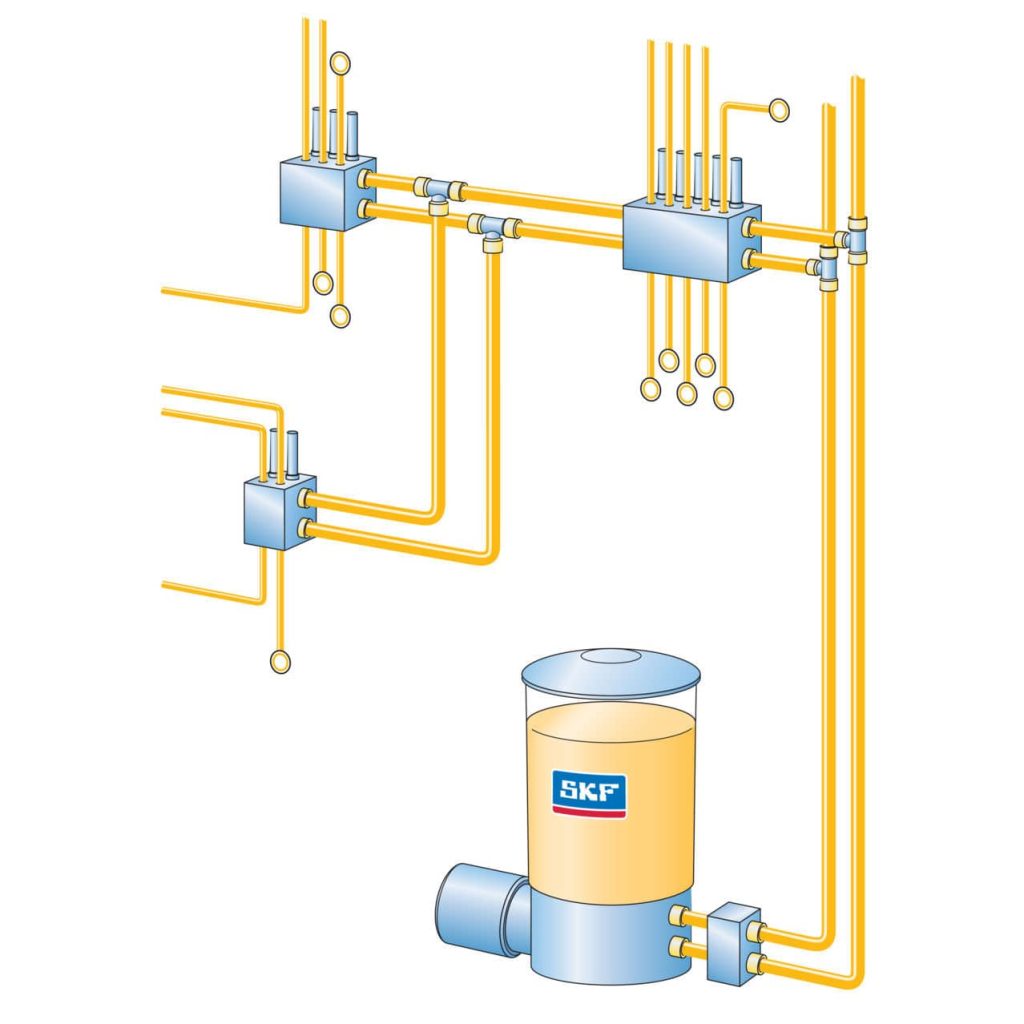
SKF dual-line systems provide precise and metered lubricant distribution over long distances—120 meters or more—to up to 2,000 lubrication points. Even if one pair of outlets in a distribution element becomes clogged, the system continues to provide adequate lubrication to all remaining lubrication points. The lubricant volume for each pair of outlets can be dosed separately, and this amount can be monitored visually or electrically.
| Advantages: | Application Areas: | |
| · Flexible structure – The design is simple, the system can be easily scaled up or down. | · Heavy industry · Metal processing plants | |
| · Reliable performance – Delivers precise and measured amounts of lubricant to up to 2,000 lubrication points at distances of up to 120 meters. | · Paper and pulp production · Mining and mineral processing facilities · Power plants | |
| · Wide range of applications – Adapts to different sectors and equipment. | · Cement factories | |
| · Works effectively in harsh conditions – High back pressure lubrication points can be used safely in harsh operating conditions such as dirty, damp or cold environments. |
SKF Dual-Line Yağlama Sistemleri Nasıl Çalışır?
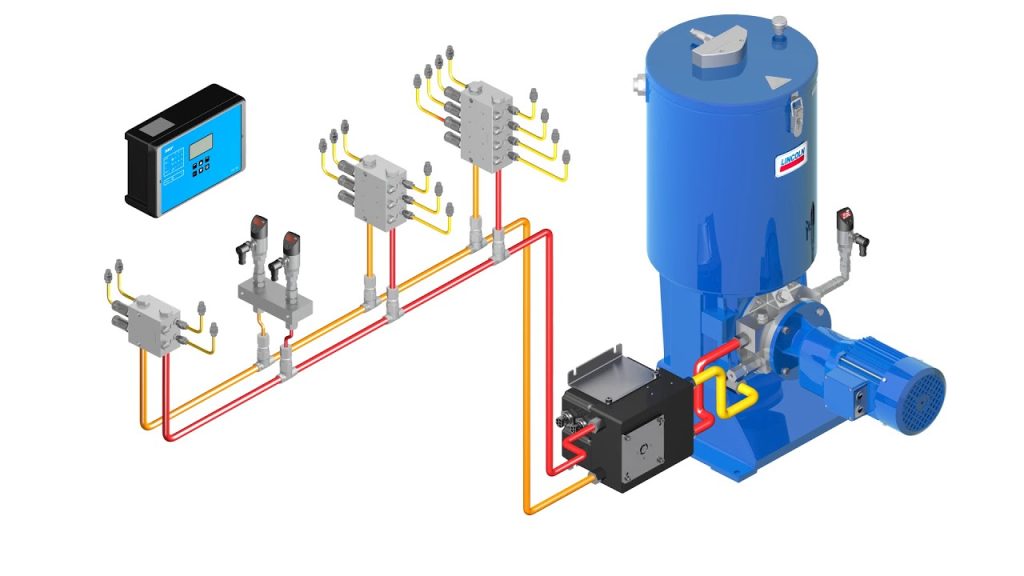
These SKF systems utilize two main lines, sequentially fed by a high-pressure pump via a change-over valve, and can operate at pressures up to 400 bar (5800 psi). Branch lines along the main lines are connected by dual-line dosing devices, providing large quantities of lubricant to the lubrication points. In large-diameter dual-line systems, end-of-line pressure switches are used at the end of the main lines for system control and monitoring.
These flexible systems are simple in design and can be easily scaled up or down by adding or removing additional dosing devices, eliminating the need for system redesign. Dual-line dosing devices can be combined with progressive dosing devices located downstream to increase the number of lubrication points and provide small amounts of lubricant to each point.
The operating principle consists of two half-cycles:
In the first half-cycle, lubricant is pumped into main line (A), while main line (B) is connected to the pressure relief line. Directed by the changeover valve, the lubricant is delivered to the dosing devices. The dosing device pistons move to their preset end positions, thus dispensing a precise, metered amount of grease.
After all dosing devices have delivered the lubricant to their consumption points, the system is hydraulically closed. This causes the pressure in main line (A) to rise, and the preset pressure is reached at the pressure switch located at the end of the line (installed in the main line before the last dosing device). The pressure switch sends an electrical signal to the control unit. The control unit stops the pump, triggers the changeover valve to depressurize main line (A), and a waiting period begins. At this stage, half of the lubrication points in the system are lubricated.
In the second half cycle, main line (B) is pressurized, and the cycle continues in the same manner.
With this method, dual-line systems provide reliable and precise lubrication at high pressure and over large areas.